



History of Sedbergh School in 50 Objects: #3: Roger Lupton Stained Glass Window


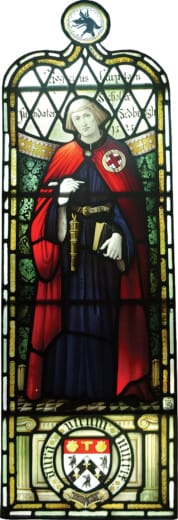
Local folk law tells that Roger Lupton, founder of Sedbergh School, was determined to gain an education. He was an ambitious young man and unable to find stimulating opportunities within his home parish of Cautley, on the outskirts of Sedbergh. Lupton apparently set off on foot to walk 300 miles to London with the intention of bettering himself. How much truth there is in this account remains to be seen, but, as our Development Director Jan van der Velde is fond of saying, ‘Never let the truth get in the way of a good story’.
Roger Lupton was born in July 1456 into a family of tenant farmers in the Parish of Sedbergh. The family home, Hole House in Cautley, still exists today if any keen Sedbergh historian would like to pay it a visit. In reality, his youthful ‘walk’ to London is unlikely to have taken place, as he is known to have been in York in 1475 where he was ordained acolyte, presumably following a period of reverent reflection in the city. From this humble clerical role, he rose in rank and wealth to become Chaplain to Kings Henry VII and Henry VIII, Canon of Windsor and Provost of Eton.
It is just possible that Lupton kept school in Sedbergh after taking his degree in Cambridge and before embarking on his career at Eton in 1504. A certain John Bland was accused of heresy in the reign of Queen Mary (1553-58) and subsequently condemned and burned. At his trial he stated that he was born in Sedbergh, ‘and brought up by one Dr Lupton, the Provost of Eton College’. The likely date of his schooling would fit with this gap in Lupton’s career in the south.
Lupton established a Chantry School in Sedbergh, tying together worship and teaching under the guidance of a Chantry Priest, Henry Blomeyr. The Chantry had certainly been in place since July 1523 when it was mentioned in a deed for the Lofthouse. This first deed made no reference to education and so it is likely that tuition came later, in 1525, as is suggested in the ‘St Andrew’s Parish Church’ article of this series.
Lupton’s post at Eton College would have made Lupton acutely aware of the value of education, and of the procedures involved in establishing endowed gifts to schools. In establishing a Chantry School Lupton declared that his intentions were both ‘for the maintaining and increase of learning in Christ’s Church’, and ‘for my soul’s health’. Teaching of the classics, known then as grammar, was to be provided free of charge by the chantry priest, however, all other tuition was charged for.
Richard Cann of the Sedbergh and District History Society comments:
‘The building and fittings for Lupton’s schoolroom meant that work and money came to Sedbergh. Also, there was the prospect of boys from wealthy families coming to the school to spend money in the town and needing lodgings. Sedbergh was starting to prosper.’
Roger Lupton’s foundation charter included gifts of land and properties in Yorkshire, allowing the governors of Sedbergh School the right to collect rent for the benefit of the school. This benevolence has been echoed by many generations of friends who have continued to donate to enhance the school. Donors to the contemporary Roger Lupton scholarships have continued this practice, offering the gift of a Sedbergh education to young people.
Roger Lupton’s legacy changed the fortune of the town of Sedbergh, and the inheritance of a fine education for generations of young people.